Profile: Marc Ravalomanana
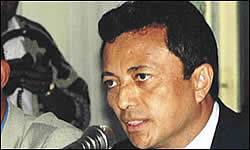
By BBC's Jonny Donovan in Antananarivo
Since the controversial 16 December elections the Mayor of Antananarivo, Marc Ravalomanana, has been gaining unprecedented levels of public support.
The self-proclaimed president of Madagascar is young, rich and good-looking.
He has a huge following in the country's capital, Antananarivo, where he has installed his own people in the government ministries of incumbent President Didier Ratsiraka.
And his image has become something of a brand name in Madagascar, where the political orientation of the people is less clear.
However, not much is known about his policies or indeed what he plans to do if he gains control of the rest of the country.
Rags to riches
A self-made multi-millionaire, Mr Ravalomanana is the embodiment of the rags to riches story.
From humble beginnings he was educated by missionaries in his village of Imerikasina, 25 kilometres outside Antananarivo.He completed his secondary education in Sweden at a strict Protestant school.
Mr Ravalomanana was in his early 20s when he abandoned the academic road to become a businessman.
He started producing home made yogurt which he sold on the streets of Antananarivo off the back of his bicycle, with the help of his wife Lalao.
Less than two years later, assisted by the Protestant Church, of which today he is the vice president, Mr Ravalomanana managed to secure a loan from the World Bank to purchase his first factory.
Today his sprawling empire TIKO, the largest non foreign owned company in Madagascar, has a monopoly on all dairy and oil products sold on the island.
"Filthy and anarchy"
As the Mayor of Antananarivo and self-proclaimed president Mr Ravalomanana has earned himself a reputation as someone who gets things done his way.
In the three years since his election as mayor, the capital has undergone a dramatic transformation.
Today it is cleaner and far more organised, comment Antananarivians.
However, Mr Ravalomanana's almost fanatical attack on what he described as the "filth and anarchy" of Antananarivo has made him many enemies.
Hardliner
There was outcry in the national assembly in September 2000 when he ordered over 100 inhabited houses deemed too ugly to be bulldozed in his clean up operation.
Mr Ravalomanana's reputation as something of a hard-liner is equally reflected in his approach to politics.
He has, on many occasions, made it quite clear that once he has gained power he will get people to work, if necessary by force.In his own words: "What the Malagasy need now is discipline."
Rural uncertainty
Although Mr Ravalomanana is an inspiration for his supporters in urban Madagascar, his popularity in the rural areas where traditionally the ruling party has enjoyed its strongest power base is uncertain.
Initially a timid public speaker with a little voice, he has grown in confidence since the election period and unlike the incumbent president he thrives upon the attention of the media.
However, Mr. Ravalomanana's habit, during the election campaign, of touring towns with an entourage of several helicopters, saying a few words and then disappearing off again did not please many in many remote areas.
Madagascar's rural voters expected to be wooed by more traditional oration, an eloquence he is said to lack.Possibility of a change
It remains to be seen whether Mr Marc Ravalomanana will be accepted now that he has installed his new government.
The question that many are asking is whether he will gain the full support of the army under the current state of martial law declared by Mr Ratsiraka.
When questioned about his socio-economic policies, Mr Ravalomanana's answers are less than satisfactory, casting doubts of whether he is sure of them himself.
However,
for the people of the capital, Antananarivo, and many more across the
rest of the vast island who have lived through 20 years of Mr Ratsiraka's
rule, the hope of change appears enough.